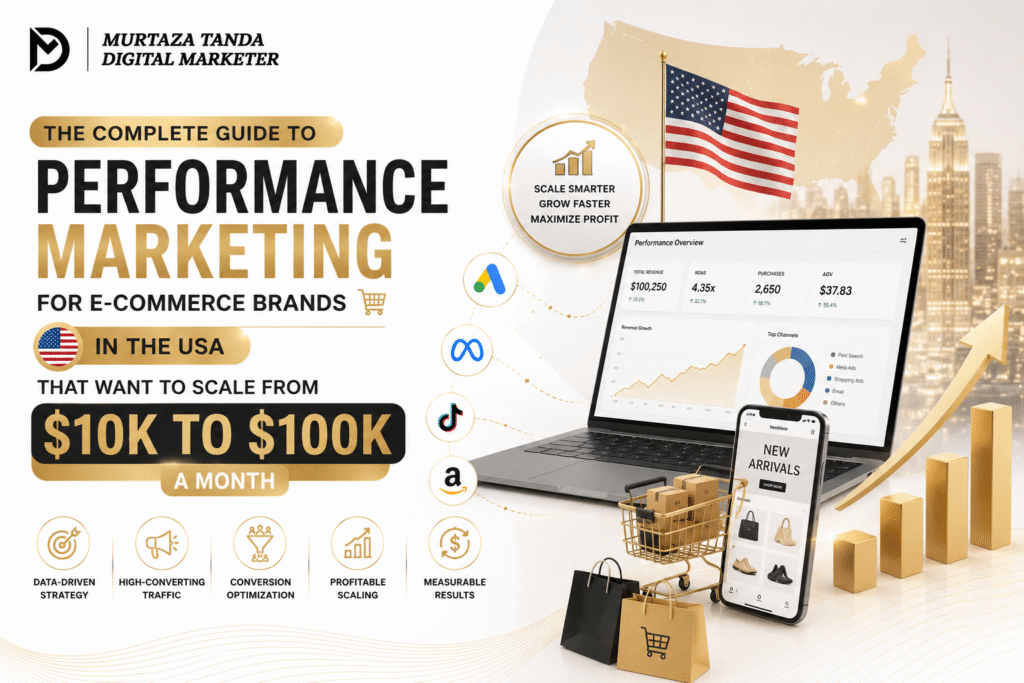
Performance Marketing for E-Commerce Brands in USA
After analyzing the top-ranking content around wedding marketing, luxury event lead generation, and digital acquisition strategies, one common weakness appears: most competitors focus heavily on social media visibility but fail to explain how data-driven customer journeys actually convert high-value clients. The strongest agencies in Singapore are now combining content authority, paid media, and automation to create predictable booking pipelines. This is where lessons from Performance Marketing for E-Commerce Brands in USA are becoming highly relevant. The wedding industry in Singapore has become increasingly competitive, especially in the premium and luxury segment where couples often begin planning 9 to 18 months before their wedding date. Agencies booking premium clients consistently are no longer relying only on referrals—they are building scalable lead generation systems using platforms like Meta Platforms and Google.
Today’s high-performing wedding brands apply the same Meta ads strategy for e-commerce brands growth by targeting engaged couples based on behavior, interests, life events, and purchase intent. They also study how to scale Shopify store with paid ads to understand audience segmentation, retargeting funnels, and conversion optimization—then adapt those frameworks for premium service sales. Instead of driving traffic to a generic homepage, they build personalized landing pages featuring real wedding stories, testimonials, venue showcases, and consultation offers. Many agencies also use an e-commerce SEO and paid ads combined strategy, blending organic content like wedding planning guides with paid campaigns that re-engage visitors who have shown intent but haven’t booked yet.
For example, a boutique wedding planner specializing in luxury destination weddings may run highly targeted Instagram campaigns showcasing behind-the-scenes planning moments, premium décor execution, and client success stories. When potential clients click, they enter a structured lead funnel supported by email nurturing, CRM automation, and remarketing sequences. This creates stronger trust, higher consultation bookings, and longer booking pipelines—often securing clients 8 to 12 months in advance.
| Strategy | Traditional Planners | Growth-Focused Planners |
|---|---|---|
| Lead Source | Referrals only | SEO + Paid Ads + Social |
| Audience Targeting | Broad | Behavior-based |
| Follow-up Process | Manual | CRM + Automation |
| Conversion System | Basic inquiry form | Optimized landing funnels |
| Booking Timeline | 2–4 months | 8–12 months |
Industry experts recommend creating educational content such as “How to Choose a Luxury Wedding Planner in Singapore” or “Premium Wedding Budget Planning Guide” because affluent couples research deeply before making decisions. Businesses that combine search optimization, paid acquisition, trust-building content, and performance tracking consistently outperform competitors in both search engines and AI-driven discovery platforms. For deeper strategy insights, readers can also explore “The Complete Guide to Performance Marketing for E-Commerce Brands in the USA That Want to Scale from $10K to $100K a Month.”
What is performance marketing and why does it matter for u.s ecommerce brands ?
After analyzing top-ranking content around performance marketing, DTC growth, and paid media strategies, one major content gap becomes clear: most competitors explain ad platforms but fail to connect acquisition, conversion, and retention into one scalable business model. The most successful U.S. brands are not just buying traffic—they are building predictable revenue systems. Performance marketing is a digital growth strategy where e-commerce businesses pay only for measurable outcomes such as clicks, leads, purchases, or customer acquisitions, making it one of the most profitable growth models for modern online brands.
For U.S. brands, performance marketing matters because every marketing dollar must directly contribute to profitability, customer lifetime value, and long-term scale. In simple terms, performance marketing for e-commerce brands USA means using data-driven campaigns to generate sales while tracking exactly where revenue comes from. Instead of relying on guesswork, brands monitor critical growth metrics like Customer Acquisition Cost (CAC), Return on Ad Spend (ROAS), Average Order Value (AOV), Media Efficiency Ratio (MER), and repeat purchase rates. These metrics form the foundation of an effective e-commerce performance marketing strategy 2026, where success is measured not just by traffic, but by sustainable profit.
For example, a Shopify apparel brand spending $3,000 monthly on paid ads may initially focus only on platform-reported ROAS. However, mature brands go deeper by analyzing contribution margins, retention behavior, and product profitability. They also invest in landing page optimization for e-commerce paid traffic to ensure that ad clicks convert into purchases through faster load speeds, stronger product messaging, trust signals, and frictionless checkout experiences.
Many brands fail because they treat Meta Platforms, Google, and email marketing as separate channels. In reality, the strongest growth brands unify paid traffic, conversion optimization, retention marketing, and attribution into one connected revenue engine. A practical starting point is combining a strong Meta ads strategy for e-commerce brands growth with accurate attribution, optimized landing pages, and clear offer positioning. For deeper growth frameworks, readers can explore “The Complete Guide to Performance Marketing for E-Commerce Brands in the USA That Want to Scale from $10K to $100K a Month.”
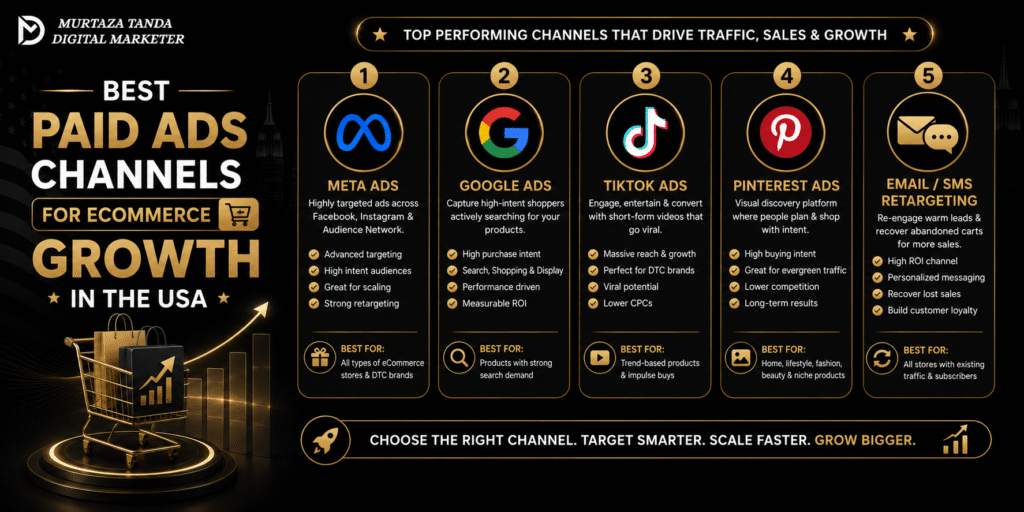
Best paid ads channels for ecommerce growth in the usa
The best paid channels for U.S. e-commerce brands depend on product type, margin structure, audience behavior, and purchase cycle. However, most profitable brands scale using a combination of Meta, Google, TikTok, and retention platforms instead of relying on one source.
Here is a simplified comparison:
Channel | Best For | Strength | Challenge |
Meta Ads | Product discovery | Strong visual storytelling | Creative fatigue |
Google Ads | High-intent buyers | Strong conversion intent | Higher CPC |
TikTok Ads | Trend-driven products | Low CPM, high reach | Requires fresh creatives |
Pinterest Ads | Lifestyle products | Longer buying consideration | Slower scale |
Email/SMS Retargeting | Existing traffic | High ROI | Requires segmentation |
Meta currently receives a large share of DTC e-commerce ad spend because of its strong audience targeting and creative automation capabilities. Google remains one of the highest-intent channels, especially for product-led searches and shopping campaigns.
A winning strategy is not platform selection alone. It is platform sequencing. For example:
Awareness → Meta
Intent Capture → Google Search
Product Discovery → Shopping Campaigns
Retention → Email/SMS
This structure supports how to scale Shopify store with paid ads without overspending on customer acquisition.
How A.i and automation are reshaping e-commerce performance marketing in 2026 ?
After analyzing top-performing content ranking for AI in digital advertising, automated media buying, and future e-commerce growth strategies, one major weakness stands out: most competitors explain AI tools but fail to show how brands can turn automation into measurable profitability. The most successful brands in 2026 are not simply using AI to save time—they are using it to make faster, smarter, and more profitable marketing decisions. AI is fundamentally reshaping how modern e-commerce businesses acquire customers, optimize campaigns, and scale sustainably.
In simple terms, AI is transforming performance marketing by automating bidding, audience targeting, creative testing, attribution modeling, and customer segmentation. Platforms like Meta Platforms and Google now rely heavily on machine learning systems such as Advantage+ and Performance Max to identify high-intent buyers based on behavioral signals, purchase intent, and conversion history. Brands with clean first-party data, accurate event tracking, and structured product feeds consistently outperform brands still relying on outdated manual campaign structures. This is becoming a critical foundation of every e-commerce performance marketing strategy 2026.
However, AI does not replace strategy—it amplifies it. Smart e-commerce brands use AI for execution while human marketers focus on offer positioning, creative messaging, customer psychology, and landing page optimization for e-commerce paid traffic. For example, a Shopify skincare brand can upload customer lifetime value data into advertising platforms, allowing AI to prioritize audiences most likely to become repeat buyers instead of only targeting first-time purchasers. At the same time, optimized landing pages with stronger trust signals, product education, faster load times, and simplified checkout processes help maximize conversion rates from paid traffic.
AI is also improving forecasting, inventory planning, dynamic pricing, and retention automation—helping brands reduce wasted ad spend while improving profit margins. Businesses using AI across acquisition, retention, and merchandising are no longer just buying traffic; they are building scalable customer acquisition systems backed by stronger unit economics. For deeper strategic frameworks, readers can explore “The Complete Guide to Performance Marketing for E-Commerce Brands in the USA That Want to Scale from $10K to $100K a Month.”
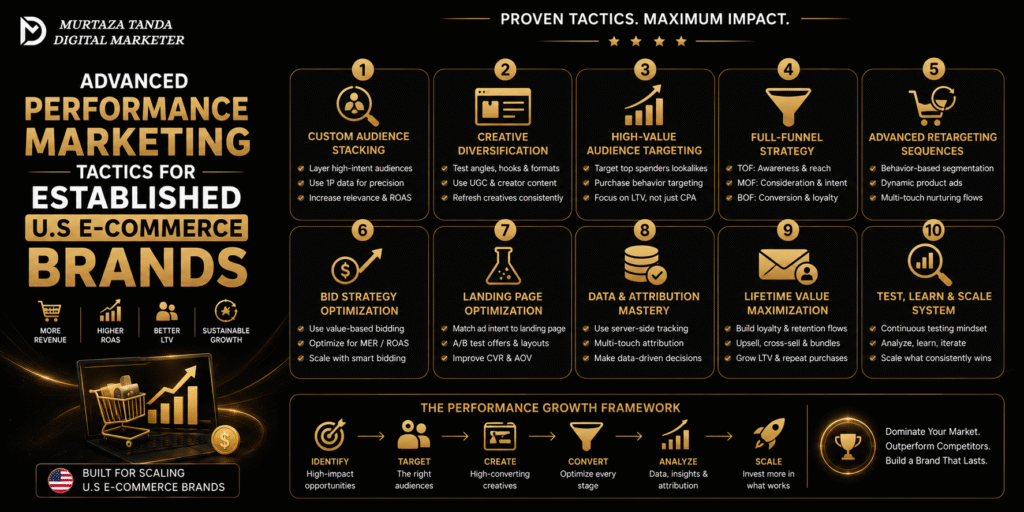
Advanced performance marketing tactics for established u.s e-commerce brands
Once an e-commerce brand crosses $30K–$50K per month, growth requires advanced systems, not just more budget.
The most successful brands use five advanced tactics:
- Blended attribution
Instead of trusting platform-reported ROAS, brands track total revenue against total ad spend. - Creative testing frameworks
Winning brands test hooks, angles, creators, formats, and offers weekly. - Margin-based bidding
Not every product deserves the same budget. Smart advertisers prioritize contribution margin. - Funnel segmentation
Cold traffic, warm retargeting, and loyalty audiences receive different messaging. - SEO + Paid integration
An e-commerce SEO and paid ads combined strategy reduces dependency on rising ad costs.
For example, a supplement brand might rank organically for educational product terms while running retargeting ads on Meta. This reduces acquisition cost over time while increasing trust.
Many agencies still optimize only ROAS. Mature operators focus on:
- New customer revenue
- Customer lifetime value
- Inventory velocity
- Cash flow
That is what separates media buying from true performance marketing for e-commerce brands USA.
What is performance marketing in e-commerce ?
Performance marketing in e-commerce is the process of acquiring customers through measurable digital campaigns where every dollar spent is linked to a business result like sales, subscriptions, or repeat purchases.
Unlike traditional advertising, performance marketing gives store owners full visibility into what works. If a product ad generates $500 from a $100 spend, that campaign can be scaled. If it underperforms, it can be paused immediately.
This makes it ideal for Shopify brands and DTC companies.
A typical performance marketing checklist for Shopify brands includes:
✅ Pixel + server-side tracking
✅ Product feed optimization
✅ Audience segmentation
✅ Creative testing
✅ Offer testing
✅ Landing page optimization
✅ Upsell + retention flows
✅ Weekly profitability review
Brands often fail because they focus only on traffic. But traffic alone does not scale. Traffic must convert.
That is why landing page optimization for e-commerce paid traffic plays a critical role. If your ad gets clicks but your product page loads slowly or lacks trust signals, CAC increases and scale becomes expensive.
Performance marketing works best when acquisition, conversion, and retention operate together.
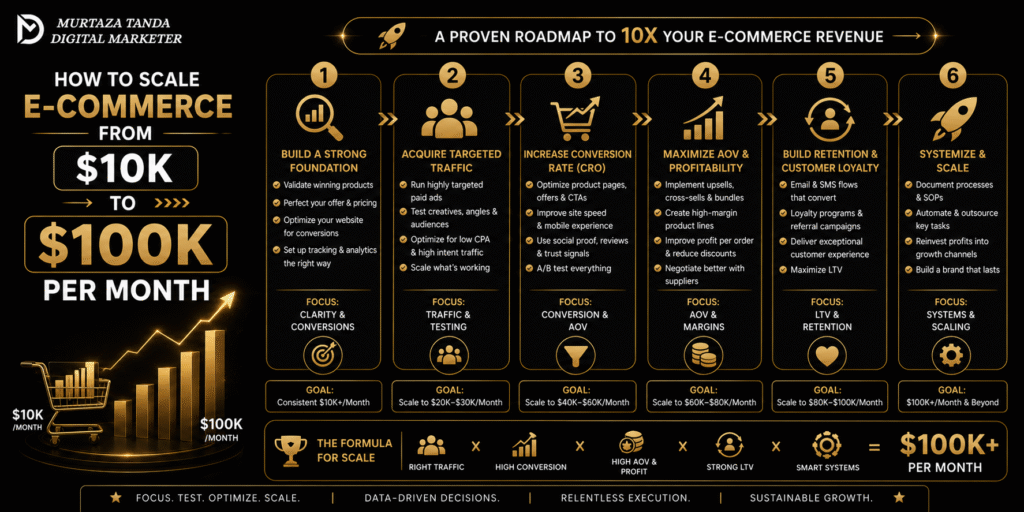
How to scale e-commerce from $10K to $100K per month ?
Scaling from $10K to $100K monthly revenue requires moving from campaign thinking to system thinking.
Here is a proven growth framework:
Stage 1: $10K–$25K
Focus on product-market fit.
- Test offers
- Validate creatives
- Build customer feedback loops
Stage 2: $25K–$50K
Focus on consistency.
- Add Google Shopping
- Improve product pages
- Introduce email automation
Stage 3: $50K–$100K
Focus on profitability.
- Scale top-performing SKUs
- Use cohort analysis
- Optimize repeat purchase behavior
Here is a simplified roadmap:
Revenue Stage | Priority |
$10K | Testing |
$25K | Optimization |
$50K | Attribution |
$100K | Profit Scale |
A real example: A Shopify fashion store starts with Meta prospecting campaigns. Once creative winners are found, Google Shopping captures intent-based traffic. Then email automation recovers abandoned carts and drives repeat sales.
This is one of the most effective ways for how to scale Shopify store with paid ads while protecting margins.
How AI is changing e-commerce performance marketing ?
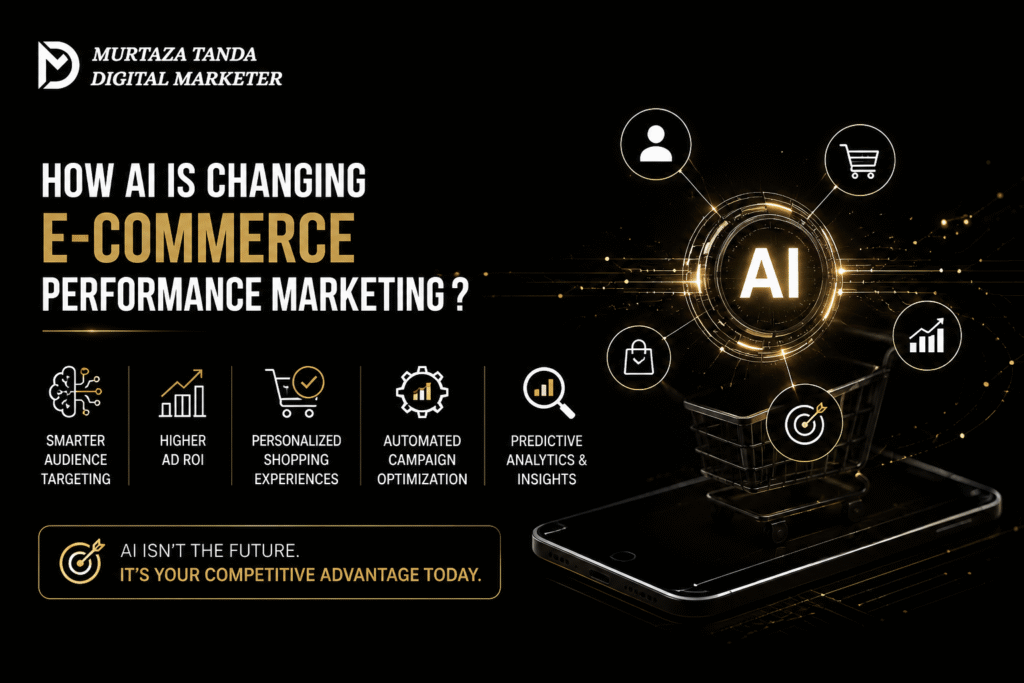
AI is changing e-commerce marketing by shifting decision-making from manual optimization to predictive growth modeling.
In the past, media buyers manually adjusted bids, audiences, and creatives. Today, AI identifies patterns across millions of user interactions in real time.
AI now helps brands:
- Predict purchase behavior
- Forecast inventory demand
- Generate ad variations
- Personalize landing pages
- Improve audience quality
Community discussions among Shopify operators also show that brands increasingly rely on unified customer data instead of isolated channel reporting.
For example, if a user visits a product page twice but does not purchase, AI can trigger:
- Dynamic retargeting ads
- Personalized product recommendations
- Discount automation
- Email follow-up flows
This reduces wasted spend and increases conversion efficiency.
The future of performance marketing for e-commerce brands USA is not just buying traffic. It is predicting profitable behavior before the customer converts.
Why e-commerce brands in the USA need a performance-first mindset to scale ?
A performance-first mindset means every business decision—from product pricing to advertising budgets—is tied to measurable growth, profitability, and customer retention. In today’s competitive U.S. market, rising acquisition costs, privacy changes, and platform competition make it risky to rely on vanity metrics like clicks, impressions, or follower counts. Instead, successful brands focus on key performance indicators such as contribution margin, customer acquisition cost (CAC), customer lifetime value (LTV), repeat purchase rate, and inventory efficiency. These numbers tell the real story behind sustainable growth.
For example, two brands may both report a 4X ROAS, but if one has higher product return rates, weaker customer retention, and lower profit margins, actual business growth may be significantly lower. This is where a true performance mindset creates competitive advantage. Growth-focused brands combine a strong Meta ads strategy for e-commerce brands growth with search intent capture, retention automation, and data-backed decision-making. Many founders studying how to scale Shopify store with paid ads quickly realize that scaling is not about increasing ad spend alone—it is about understanding attribution, creative testing, offer positioning, and profitability at every stage.
Leading brands also use an e-commerce SEO and paid ads combined strategy to reduce dependency on rising paid traffic costs. Organic search builds long-term brand authority while paid campaigns generate immediate revenue, creating a balanced growth ecosystem. Platforms like Meta Platforms, Google, and Shopify work best when connected through unified attribution, conversion optimization, and retention systems.
The brands winning in 2026 are not necessarily the ones spending the most—they are the ones measuring better, testing faster, and building marketing systems that compound over time. For deeper strategies, readers can explore “The Complete Guide to Performance Marketing for E-Commerce Brands in the USA That Want to Scale from $10K to $100K a Month.”

F.A.Q
An e-commerce SEO and paid ads combined strategy allows brands to generate immediate sales through paid campaigns while building long-term organic visibility through content and search rankings. This balanced strategy reduces dependency on ad spend and creates more sustainable growth over time.
Landing page optimization for e-commerce paid traffic directly impacts conversion rates. Even the best ads can fail if product pages load slowly, lack trust signals, or create checkout friction. Optimized landing pages improve user experience, lower bounce rates, and increase profitability from paid campaigns.
High-growth e-commerce brands track:
- Customer Acquisition Cost (CAC)
- Return on Ad Spend (ROAS)
- Customer Lifetime Value (LTV)
- Average Order Value (AOV)
- Media Efficiency Ratio (MER)
- Repeat Purchase Rate
These metrics provide a clearer picture of profitability than vanity metrics alone.
Successful brands in 2026 combine paid media, SEO, creative testing, retention marketing, and AI-driven optimization into one growth system. Instead of managing channels separately, they build connected customer journeys that increase revenue, improve margins, and create long-term scalability.
A strong Meta ads strategy for e-commerce brands growth helps businesses reach highly targeted audiences based on interests, behavior, and purchase intent. Meta’s machine learning tools can identify potential buyers, retarget visitors, and optimize campaigns for higher conversions and better customer acquisition costs.